
When Laughter Holds Up a Mirror
How might comedy expose hypocrisy, contradictions, assumptions, societal norms, or blind spots?

What Happens After the Punchline?
Now that we’ve comfortably explored whether an experience is shaped more by the performance, the room, or those sharing it with us, Dear Loved Ones, I’d like to consider what the encounter might reveal about us—and what it might teach us—as individuals.
If a joke exposes something, does our laughter sharpen our awareness, lower—or raise—our defenses, or awaken our humanity?
What responsibility do we each bear for recognizing, acknowledging, and thoughtfully considering what the performance reveals?
Do we dismiss, deny, examine, discern, or change?
Of course, not every joke carries a hidden lesson, and not every laugh needs to be placed beneath a microscope. Sometimes comedy is simply playful, absurd, surprising, silly, or even delightfully stupid.
Sometimes laughter offers rest rather than revelation—and rest can be a much-needed gift too.
But when something follows us beyond the punchline—when a joke unsettles us, illuminates something, or lingers after the laughter fades—perhaps it is worth wondering why.
Can comedy expose our blind spots?
Comedians can bring disturbing truths and societal grievances to the surface. But orientation, interpretation, intention, credibility, and action are not the same.
Comedy may expose a blind spot without necessarily clarifying or representing it accurately. And quite possibly, we misinterpret what has been excavated—in everyday life, and in how we internalize and integrate the joke, the comedian, or even our own reaction.
Because comedy may hold up an imperfect mirror, we still need handfuls of grace and discernment—not to mention humility and the light of Adonai—to recognize what the reflection is actually revealing.
Removing the Rose-Colored Glasses
For those who aren't familiar, rose-colored glasses do not prevent us from seeing, Dear Loved Ones. They tint what we see—softening reality into flattering, comforting, or idealized interpretations we may prefer over the truth before us.
Some blind spots are not hidden in darkness.
They are softened by the stories we prefer to tell ourselves.
Or, perhaps, were told by others...
Perhaps we need to pause and ask ourselves:
- Are there distortions in the lens through which we are looking?
- What might we be misreading, misunderstanding, or misinterpreting?
- Whose behavior are we examining—and what might we be overlooking or excusing?
- What does our reflection reveal?
Sometimes these rose-colored glasses make it easier to identify someone else’s hypocrisy while protecting our own. Sometimes we aren't even aware we are wearing any. Other times, we weren't the ones who put them on.
We may not have chosen every lens through which we learned to see.
Perspectives may be inherited from family or culture—or shaped by community, experience, wounds, education, and environments—long before we know enough to examine them.
Not every blind spot is a consciously chosen moral failure. But once we recognize its influence, we can begin discerning whether it truly helps us see truthfully.
We may not have chosen the lens.
That does not mean we must continue looking through it unquestioningly.
It can feel uncomfortable—dangerous, even—to venture into the minefield of our blind spots, double standards, and biases (mine included). But are we willing to do so in an effort to become who and what Adonai asks us to be?
Please remember that I am on this journey alongside you, Dear Loved Ones—that I am by no means perfect, nor do I know how to be. Not by any stretch of anyone’s imagination—or any rubber band’s.
I have just as much work to do on myself as the next person. Perhaps more in some areas and less in others, but it is all part of the journey—or minefield—regardless.
Self-reflection is an important part of the process of becoming.
The question—or perhaps the quest—is:
Are we willing to try?
We must be careful, too, though: while self-examination can be incredibly powerful and valuable, it can become its own distorted lens when it slips into simplistic condemnation. I know this from personal experience as well.
Somewhere along my recent journey, I encountered an idea that struck me like an arrow to the heart. It was something I had never heard, but desperately needed to hear:
true humility is not thinking less of oneself,
but thinking of oneself less.
The goal is not to reduce ourselves—or one another—to a single moment, choice, blind spot, prejudice, wound, failure, or otherwise.
It is to see more truthfully
so we can respond more faithfully.
Discovering a blind spot through careful, thoughtful, and purposeful introspection can feel intimidating. It may question—or even threaten—our perceptions, perspectives, identities, certainties, loyalties, relationships... or even our understanding of ourselves.
It can shift our entire lives, the world as we know it,
or the paradigms through which we live.
However, it can also lead to the unimaginable reward of deeper, more meaningful, honest, and intimate connection with—and understanding of—one another, ourselves, the world, and our Creator.
Comedy might unearth something. Our laughter or silence alone cannot tell us whether we have correctly identified what was buried—or whether we have understood it wisely.
Condemnation decides it has already seen or heard enough. It can leave us stagnant and unchanged—perhaps even pulling us more deeply into the distortions we have refused to examine.
Discernment opens a door—one that may reveal we are still willing, and perhaps even ready, to learn and grow. We must still choose to walk through that door and onto the path, trusting that Adonai will remain with us not only in our best moments, but in our hardest, darkest, and most challenging ones as well.
Through mindful practice, ever-developing maturity, and growing awareness, we can ask questions like:
- Can exaggeration expose a contradiction we have normalized?
- Can laughter help us recognize an uncomfortable truth before we are ready—or willing—to name it plainly?
- Can laughter help us face what is uncomfortable—or give us another way to evade it?
- Could facing that discomfort lead to courageous conversations and compassionate action?
A laugh is not a confession, Dear Loved Ones, and silence is not proof of virtue. Still, either may possibly offer clues that lead toward deeper insight and greater wisdom.
Comedy does not always need to teach us something. But when it does reveal something—or when something continues tugging at us—we can choose whether to look away or look more carefully.
What brings us relief? What makes us uncomfortable? Are we defensive?
Do we laugh from recognition, belonging, affection, nervousness, superiority—or simply because the room has made laughter feel permissible?
Perhaps the encounter reveals not only what we believe, but what we fear, protect, excuse, recognize, or long to have acknowledged.
A Platform for Change?
If a mirror remains when the laughter subsides, what are we willing to do with the reflection we have been invited—or perhaps forced—to confront, Dear Loved Ones?
From religious, sexist, racist, crude, or politically charged jokes about societal extremes, family matters, abortion, police brutality, and everything in between, comedians can illuminate topics people are frequently afraid to discuss openly and honestly.
Somehow, they can even bring these subjects into a roomful of strangers—where, perhaps, we can begin approaching them with greater compassion, respect, and patience for one another while literally laughing out loud together.
Maybe these comedic exaggerations expose uncomfortable truths, remove the rose-colored glasses, address inequalities, and reveal the different plights we each face—bringing forth thoughts some of us may already be contemplating and perhaps uniting us by pulling at our heartstrings—or better yet, our humanity strings.
What if we choose to appreciate a comedian's willingness, ability, and courage to start important conversations? Perhaps even accept the joke as an invitation to connect with someone else's hard?
Maybe—just maybe—you are even someone in the audience who finally feels seen.
Of course, comedians do not necessarily approach these controversial subjects with prudence—or even with the intention of sparking change.
Perhaps, however, these encounters can inspire us to practice greater grace and discernment not only within ourselves but also with one another as we carry their questions into the world beyond the room.
Practicing Compassionate Wisdom
Comedians sometimes brilliantly shed light on real issues, highly controversial topics, and even disturbing aspects of life that society has normalized.
Whatever the comedian intended, maybe an unsettling joke might help us realize that there is still work to be done. Maybe it will spark a fire in each of us to help create a world that is a little brighter and kinder—to do our part, however imperfectly, in preparing the way for the fullness of God’s Kingdom here on Earth.
Sounds easy enough, but I think we all know it's surprisingly difficult.
But hey, if laughter helps us start to become more honest, compassionate, and willing to communicate with the goal of better understanding one another, personal growth with some humor still sounds like a pretty good time to me 😄
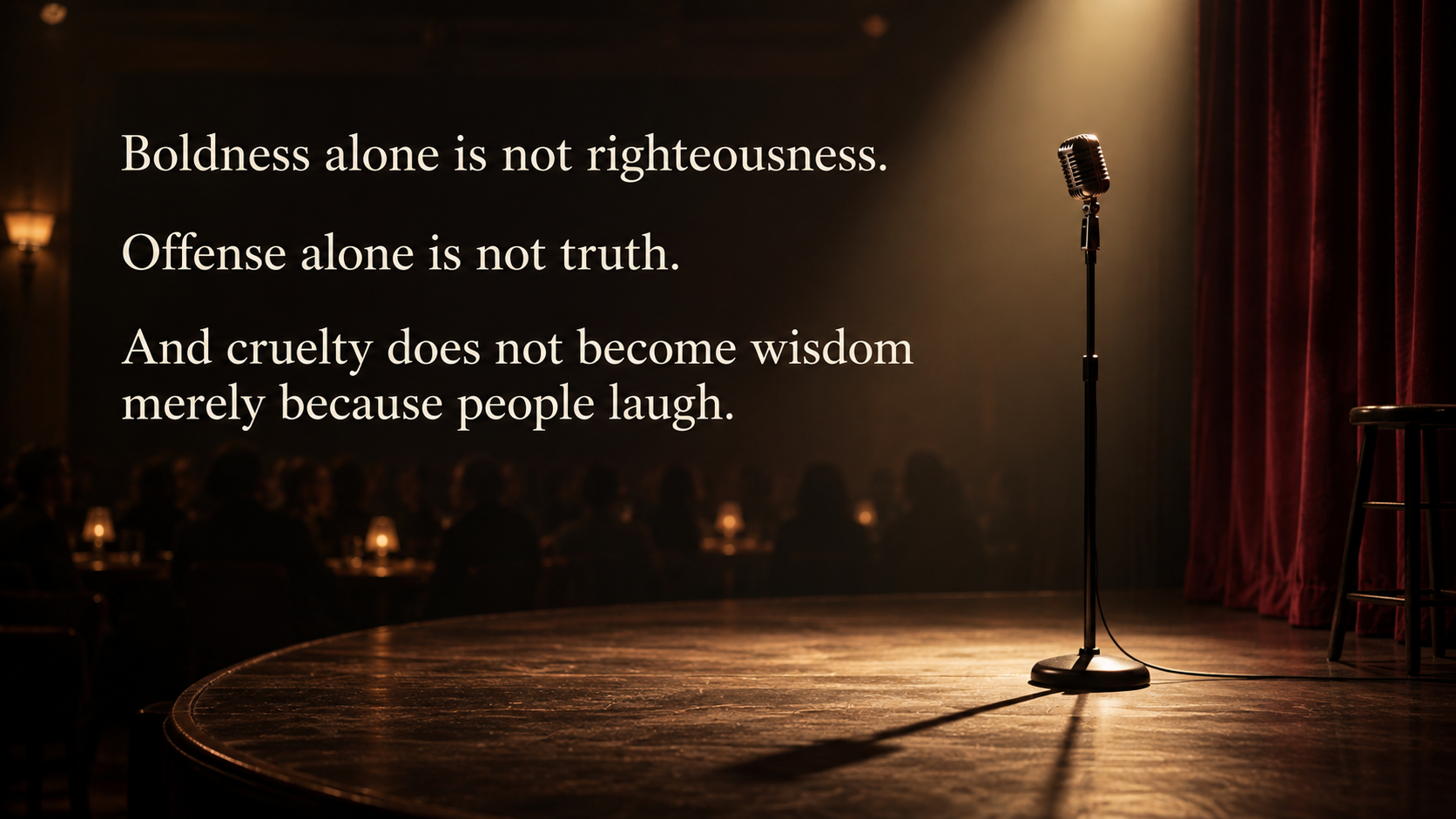
Even so, Dear Loved Ones, laughter can only begin the conversation.
The deeper work begins when we are willing to let Adonai show us what the joke alone cannot—and open our hearts to receive wisdom only He can reveal.



Comments ()