Testing the Waters
Stuck in the past(a)...
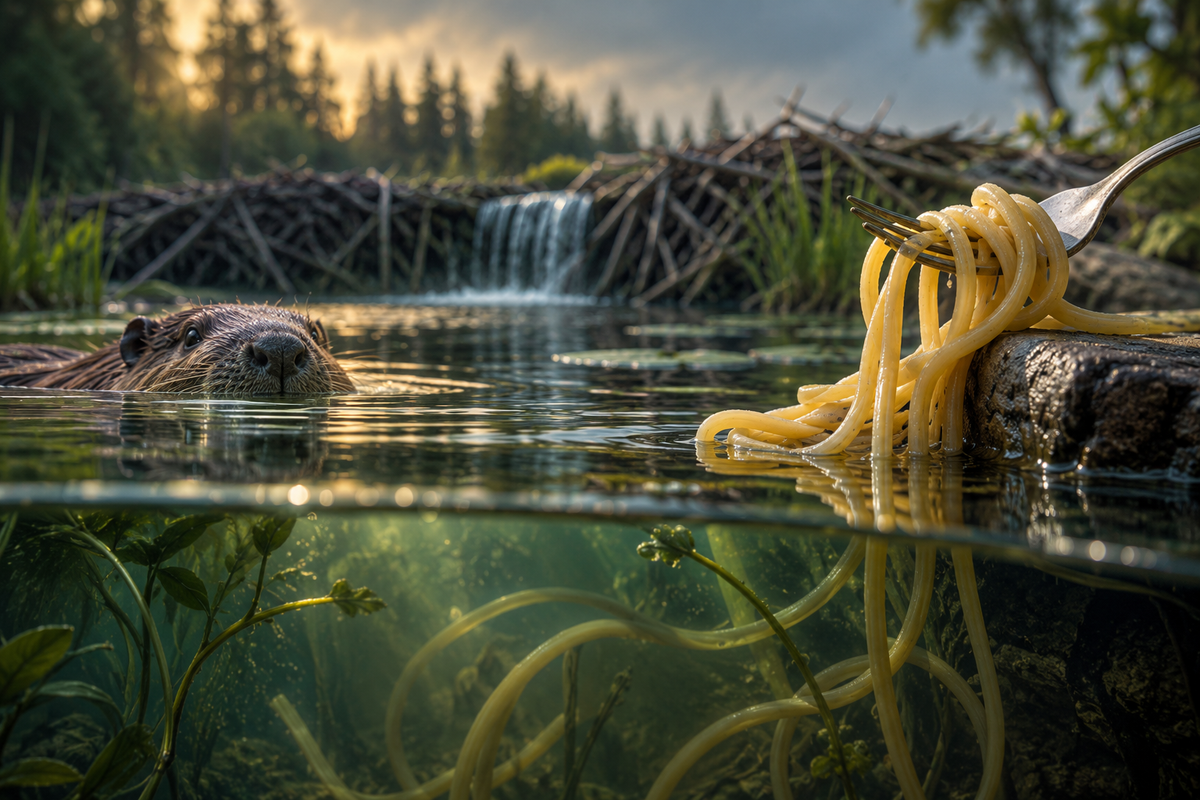
From Pond Scum to Pasta Noodles?
Remember, Dear Loved Ones, when I said tissues need to move in relationship with one another?
Well... let me tell you about buttered pasta... 😂
As we started to learn previously in Grace & Discernment, something that happens in one part of an ecosystem often affects the whole.
That ecosystem might be in the literal sense of the term, or it might be the ecosystem that is our body, a family, an organization, a community, or any number of interconnected relationships.
Today we will expand on this bodily metaphor while continuing to unpack Grace and Discernment in our daily lives.
Because just as ecosystems respond and adapt to change, so do we.
Sometimes things occur in life that make us feel lost in our journey, and while it is understandable that we want to 'get back' to who we used to be, I think it's more about discovering who we are now.
Exploring who we are now can be a challenging transition. One that asks us to be patient, and ideally kind, as we process and adjust.
Perhaps we've become a parent or caretaker, newly single, recently married, or suddenly the one being cared for.
Perhaps we're transitioning from conventional employment to becoming an entrepreneur, homesteader, retired, or even a wanderer.
Career changes. Educational demands. Lifestyle adjustments. Relocation juggling. Unexpected, devastating injuries that alter lifestyles, careers, and relationships.
Or wars that not only disrupt daily life and livelihoods, but devastate landscapes and ecosystems, destroy lives, and leave enormous wakes behind them.
As life evolves, we can find ourselves struggling to understand our place within what life looks and feels like now. It's okay to tread cautiously through unfamiliar territory, but I encourage us all to continue seeking wisdom and discovering trusted companions along the journey.
Perhaps sometimes restoration isn't returning to some untouched original version of ourselves.
Perhaps healing isn't about becoming who or even what we were before something happened.
Perhaps it is learning to faithfully inhabit who we are now.
We are living, learning, adapting, becoming creatures—and Adonai is present within all we have experienced and all we are becoming.
And yes, somehow our buttered pasta is going to help us continue exploring all of these entanglements woven into the expedition of life. 😂
But first...
A dam isn't inherently bad.
Our bodies are so much more amazing than I can begin to explain. For one, they are incredibly forgiving and resilient—just like nature itself.
In nature, beaver dams create wetlands, alter ecosystems, provide habitat, slow water, and change the landscape in ways that can be extraordinarily beneficial.
It's another reason I still love the beaver pond metaphor so much. Because while there can be complications, there can also be positive benefits to damming a stream.
Likewise, our bodies continually evaluate and adjust. Sometimes an adaptation serves us remarkably well even in the long term. Other times, the body can become as ensnared and complicated as our lives might feel.
Yet, if and when we are ready, willing, and able to receive it, perhaps our challenges and modifications have something to teach us too.
Quick (but important) side note.
If you're wondering what in the world beaver ponds have to do with our body 😂, I highly recommend starting there.
You can follow the Grace & Discernment link near the beginning of this article—or simply click below.
Tangled Web
When movement changes in one part of an interconnected body, other parts often begin responding too.
Our beaver pond metaphor helped us imagine how stagnation alters flow creating accumulation throughout an interconnected ecosystem.
The promised pasta illustration will help us imagine something different: restriction in movement.
Each one affects the web of connective tissue that is foundational to, for, and within our body's ecosystem.
Neither metaphor perfectly describes what happens within a living body—and one doesn't necessarily follow the other.
Together, however, they give us different ways of imagining what can happen when movement, flow, and relationships within an interconnected system begin to change, or even break down.
Either development can create a sort of entanglement that affects tissues, flow, energy, function, and the synergy between them.
These kinds of alterations aren't limited to our bodies. We encounter these dynamic and ever-changing ecosystems, circumstances, and relationships throughout the world around us and woven into our everyday lives.
One seemingly tiny, simple thing has the capacity to announce a need for our attention.
Much like a single strand of dragline informs a spider of movement elsewhere in the web, even subtle changes can have a wide range of interactions throughout an interconnected system.
Slip and slide.
Within our bodies many tissues need to be able to move and glide in relationship with one another. Especially the connective tissues throughout and surrounding various parts of the body.
One of the ways I used to explain this to clients was by asking them to imagine delightfully separate buttered pasta strands rather than several pasta strands boiled into a clump that is essentially glued together.
Not terribly scientific, perhaps. ;P
But easy to picture.
Pasta that's been cooked with a watchful eye, then gently oiled or buttered, slips and slides without getting caught on itself. Each strand remains distinct while still moving alongside—and in relationship with—the others.
Sticky pasta, on the other hand, begins clumping together. Individual strands no longer slip and slide past one another quite so freely.
Our tissues are infinitely more complex than a pot of noodles 😂, but this was one simple way I helped clients imagine what restriction can feel like.
Sometimes when tissues become irritated, injured, guarded, overloaded, repeatedly stressed, or even increasingly efficient at particular patterns, they may no longer move as freely—both independently from and in relationship with one another—as they once did.
Sometimes tissues can quite literally become adhered to one another—hence terms like adhesions—which can restrict movement, range of motion, or even function. While at times tissues feel stuck in this glued manner, other times what I felt beneath my hands was more like entanglement.
Perceived restriction can feel different depending on what might be happening in the body, as well as where it is located, and the type of tissues we are working with. Beneath my hands, I noticed differences in density, tension, tenderness, mobility, responsiveness, and more.
While I often joked that, sadly, I did not—and still do not 😂—have Superman's x-ray vision, helping people better understand what could be happening within their bodies often felt like a powerful part of the healing process.
Then there are those familiar little “knots” many of us have experienced, commonly associated with what are called trigger points.
These aren't necessarily the same thing, Dear Loved Ones—and that distinction deserves more attention than we're going to explore in this article.
For now, our sticky pasta gives us an admittedly imperfect but wonderfully visual way to imagine a simple idea:
Things get stuck. They aren't moving as freely as they could.
And the body responds the way it knows how.
It adapts.
Despite the analogy, the question isn't how to avoid ever having stuck past(a), but how we respond to it. We cannot escape all the stickiness of life, after all.
Rather... how do we respond compassionately and mindfully to our bodies—and our lives—as they continually change?
Do we become stuck—like clumped-together pasta—trying to return to exactly who we once were? Or, can we learn to move within the life—and various ecosystems—we inhabit now?
Change is inevitable.
Like it or not, life comes with its share of beaver dams, pond scum, knotted-up pasta, and many other metaphors we will eventually explore.
We may not get to choose everything that happens to us, Dear Loved Ones—or even all the ways we initially react and adapt. Perhaps, however, we can learn to participate more intentionally in, and even shape, what happens next.
Perhaps more importantly, as we learn to hold ourselves with love, patience, and understanding, how might we extend that same compassion into the ecosystems and relationships we interact with daily—with continued Grace and Discernment?
What might our adaptations be showing us?
While it might be uncomfortable, frustrating, even devastating, our limitations can teach us. Our compensations can teach us. What becomes difficult can teach us. What our bodies resist or accommodate can teach us.
Adaptations don't merely change us.
They can reveal something to us.
Likewise, circumstances in life can reveal things about our habits, priorities, relationships, character, assumptions, strengths, wounds, tradeoffs, etc.
No, we don't need to turn every terrible thing that happens into some compulsory “lesson” or what's been coined "toxic positivity", Dear Loved Ones.
Receiving what an experience might have to teach us is an invitation, and possibly an opportunity—not an obligation.
Sometimes surviving is enough.
Sometimes understanding comes years later.
And sometimes, perhaps, there isn't a tidy lesson at all.
But... what if adaptation isn't the enemy?
One of the most incredible things about the human body is its ability to learn, self-regulate, fine-tune, and ultimately become better and more effective at what we repeatedly ask it to do.
Things that once required considerable effort can become easier, quicker, and more optimized—from basic functions and movement patterns to complex communication pathways.
Through practice and repetition, tasks that once required tremendous concentration can eventually feel smoother, more coordinated, even almost automatic—just like skills we develop throughout our lives.
Think about learning to walk, ride a bicycle, type, play an instrument, or perform the movements required for a sport or profession.
Our bodies are extraordinary students.
While our adaptations become part of us, and what happens to us can absolutely influence us in a multitude of ways, we aren't simply what happened to us.
What happens is one small part of our story.
How we respond is another part of our story.
How we learn, grow, and evolve becomes part of our developing self.
No single event, reaction, adjustment, limitation, strength, wound, response, or tradeoff—alone or combined—encompasses the entirety of who we are.
Just as we learn, cope, and move forward as best we know how—sometimes coming up with creative solutions—so do our bodies.
Caution, though.
Efficiency can come with tradeoffs.
Imagine, for instance, a runner who repeatedly trains the body in essentially the same movement patterns without enough cross training.
The body can become highly effective at producing those repeated movement patterns. That's wonderful—until increasing efficiency of those motions comes with tradeoffs in mobility or adaptability elsewhere.
Certain areas may become more dominant while others contribute less.
Range of motion, strength, flexibility, and agility may change.
Compensation can shift from mere habit to an increasingly ingrained attribute.
Of course we don't only have to be runners for this to happen.
Just like we can sometimes become stuck in our ways of doing things, muscles may become accustomed to working together in particular patterns.
The body isn't betraying us. It's adjusting.
There are countless reasons our bodies modify, streamline, and recalibrate how they function. An adaptation itself isn't necessarily the problem. It's a natural part of life.
I don't believe the goal is to somehow prevent our bodies from adapting, or aging, but to recognize when, how, and what, changes are occurring.
As I also often say, there are pros and cons to everything.
The goal is balance.
Perhaps we can support our body, ourselves, and one another with whatever variety, movement, nourishment, rest, recovery, growth, and care we are ready, willing, and able to offer in any given moment or circumstance.
Our bodies adjust to work, sleep, repetitive movements, overuse, underuse, injury, stress, how we sit and stand... even what we think and how we feel.
Any of these can influence how we move and function elsewhere in the body—sometimes nearby, sometimes surprisingly far from where a pattern began.
It's not a question of whether we've adapted. We will. Life ensures it.
The question is, are we paying attention?
Another. Are our adaptations continuing to serve the whole?
As things change, Dear Loved Ones, perhaps Grace allows us to honor what helped us get here, while Discernment asks whether it still serves where we're going.
What once served us well does not become bad simply because circumstances have changed.
Nor does honoring what once served us mean we must remain exactly as or where we are.
We can appreciate what helped us survive, function, learn, grow, heal, or simply make it through, while continuing to discover what life asks of us now.
Because we are still living.
Still learning.
Still adapting.
Still becoming.

Comments ()