
Ready for Cooler Weather?
What exists within us—that which we knowingly and unknowingly carry—often becomes visible and tangible through how we treat one another.
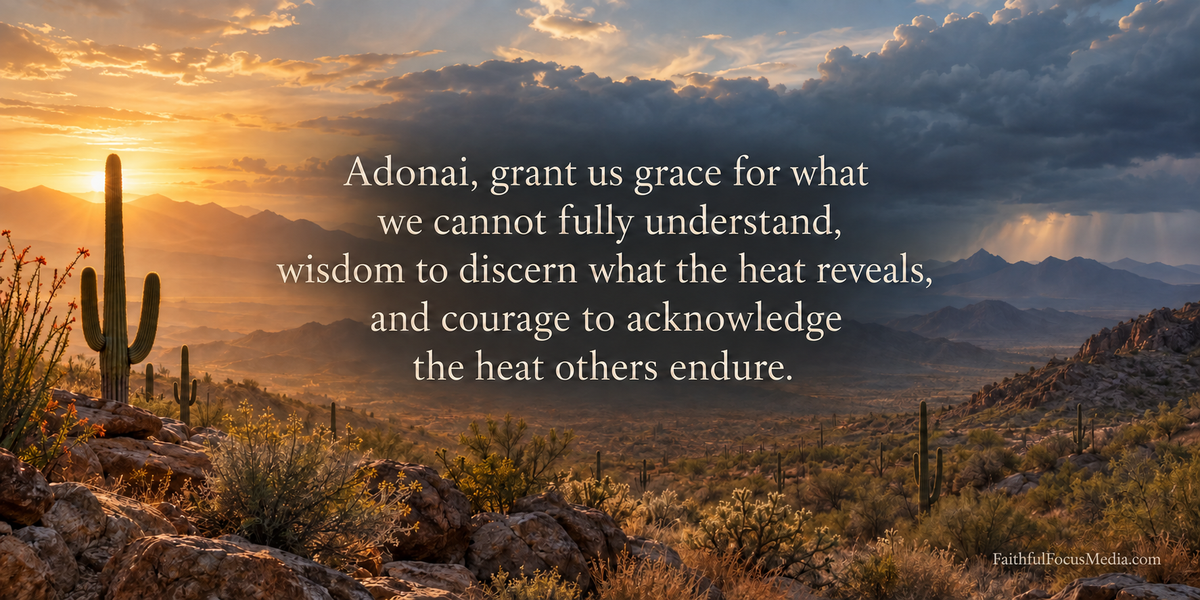
What Might the Heat of Summer Reveal About Us in Tough Times?
Much like the heat of summer, Dear Loved Ones, life brings pressures that challenge us—perhaps even beyond our limits.
While summer begins to wind down into the delightful season of Autumn, I cannot help but wonder how the changing seasons of nature can at times be very similar to what is happening in our daily lives.
Just as the summer heat can become harsh, some seasons of life can feel challenging—even cruel—through betrayal, war, devastating injuries, crippling setbacks, or any number of heart-wrenching circumstances.
Other times, change arrives in the most wonderful, exciting, even adorable ways—like a litter of kittens dropped at your door or the arrival of a long-awaited baby—offering their own set of challenges and blessings.
Adjusting to change, regardless of how terrible or wonderful, can be intimidating and trying. It can disrupt our routines, strain our resources, reshape our relationships, and even lead to a loss of self or purpose.
Seasons of life will ebb and flow.
At times, they may intensify like the heat of summer, bringing whatever has been quietly simmering within us to a rolling boil—bubbling and bursting at the surface.
Such experiences can expose, even to ourselves, what we have been carrying.
Beyond what spills into our choices, relationships, and shared experiences, what else might these moments reveal?
What might the heat draw to the surface that otherwise might have remained buried?
And perhaps just as importantly, what might recognizing our own response to life's heat teach us about the experiences of others?
A few days ago, as I was trying to decide which task to conquer, I chose to read the introduction to John C. Maxwell’s Leading in Tough Times, a book about organizational leadership. Within the first paragraph I was confronted with something I have not only said often, but have even been chastised for:
Life. Is. Hard.
It might be silly, but I felt validated. Vindicated even.
I don’t think acknowledging adversity—or admitting that “life [can be] hard”—diminishes or devalues the wonder, beauty, joy, and gift of life itself.
In fact, I think doing so may actually add another thread to its brilliantly complex and interconnected tapestry.
I’m talking about honoring the experience.
Not just our own story, Dear Loved Ones, but also—or perhaps in particular—the life, circumstances, and experiences of other people.
Life is an individual experience.
While we might all experience the seemingly “same” hot day—metaphorically or in actuality—we each perceive and experience it differently.
Sure, the temperature on the thermometer might read the same for all of us, but that doesn't mean we all handle it the same.
For instance.
- One person may spend most of the day moving between an air-conditioned home, vehicle, and workplace.
- Another may be repairing roofs, landscaping yards, delivering packages, working construction, or otherwise spending hours outside.
- Someone may have reliable air conditioning while someone else's has just broken.
- One person may tolerate heat remarkably well while another struggles tremendously.
The temperature may be the same, Dear Loved Ones, but the experience isn't.
Wouldn’t the same be true of life's other pressures?
We are individuals with our own stories. Two people can experience circumstances that look remarkably similar from the outside and respond to them very differently.
Living through the heat of summer provides perspective on the uncomfortabilities life can sometimes throw our way.
We each have our hard, and we each walk through it in our own way, but how quickly and easily can we be tempted to compare.
- Well, I went through something like that…
- Why don't they just…
- If they would only…
- They chose...
Perhaps sometimes we're even right.
But how much do we actually know about, understand, or are able to relate to how the temperature feels where someone else is standing?
We don't necessarily know everything that came before this particular season.
We don't know every loss they have accumulated. Every lesson they were—or weren't—taught. How much support they do or do not actually have.
We don’t know their struggles, hurts, fears, or perceived failures.
We don’t know what resources have or haven’t been available to them, every responsibility they are carrying, every test they are surviving, or what else might be quietly simmering beneath the surface.
We cannot know the entirety of another person's story.
And they equally do not know ours.
Recognizing that doesn't require us to excuse every behavior, pretend that choices don't have consequences, or enable abuse.
It simply invites us to once again practice Grace and Discernment.
To gain understanding and offer compassion.
To become a little slower to assume, judge, or compare another person's ability to withstand a heat we aren't standing in ourselves.
Because heat not only tests—it reveals.
Heat can transform.
It can soften.
Harden.
Melt.
Temper.
Burn.
Even refine.
Life's pressures—'heat'—can do something similar within us.
Hardship may reveal generosity, patience, ingenuity, perseverance, faith, a willingness to give or receive help, or a courage we didn't know we possessed.
Pressures may reveal fear, anger, pain, anxiety, resentment, pride, impatience, avoidance, a desperate need for control. They may expose wounds we thought had long since healed—or, surprisingly, even joy and gratitude.
Just as shockingly, happy changes can unearth parts of us—or responses within us—we have never encountered before. Perhaps delivering temptations we never imagined we might succumb to.
Whether what surfaces reflects our God-given capacities, our human frailty, or some complicated mixture of both, these revelations need not first be met with condemnation, shame, or guilt.
They invite us, Dear Loved Ones, to pause.
To hold space.
To become curious about what is rising to the surface.
To really behold what is there.
To sit with it, ask where it came from, and just be—for a moment.
These are moments of opportunity to recognize what the pressures of this particular season might be drawing out of us—and what they might be teaching us about ourselves.
Perhaps this is one of the quieter lessons hidden within life's difficult seasons:
Our own experience of heat can teach us something about compassion.
When we recognize that someone else's hard may not look anything like our own, we tap into that interconnected tapestry and create a ripple.
When we remember what it feels like to be overwhelmed, perhaps we become gentler with someone who is overwhelmed by something we ourselves might find easy or simple.
When we acknowledge how circumstances have affected our own choices, perhaps we become more curious about what might be affecting someone else's.
When we recognize how much of our own story remains invisible to the people around us, perhaps we remember that much of theirs is invisible to us too.
None of this means choices don't matter,
because they do.
It doesn't mean our intentions, actions, or their effects don't matter. They do.
Nor does compassion mean that everything becomes acceptable simply because we recognize that someone's life has been hard.
There are important questions—questions of responsibility and accountability. Of discernment, consequences, grace, and what belongs to each of us to carry.
But perhaps we don't have to answer all of those questions at once.
For today, perhaps it is enough simply to notice the heat.
To sit with it and ask:
What is this season revealing?
What assumptions am I making about someone else’s ability to withstand their own season?
Which hardships have we chosen?
Which hardships have chosen—or simply found—us?
What hard things are each of us standing in today?
And what choices are still ours to make?
What Comes After the Pause?
Eventually, what we discover may ask something of us.
We may need to respond, repair, seek help, establish a boundary, change direction, or take some other faithful step.
Pausing is not the final action;
it is what allows the next action to be wiser.
The purpose of pausing is not to remain indefinitely within what has surfaced. It is to give ourselves the time and space to discern what—if anything—we are being invited to do next.
Maxwell writes about the potential to approach adversity as a teaching tool.
While I agree that we can grow from hardship, perhaps what they teach us is not limited to leadership, resilience, or self-discovery. Perhaps our own experience of life’s pressures can also teach us compassion for people standing in circumstances we cannot fully see.
And perhaps that compassion can help shape what we choose to do after we pause.
Grace Along the Way.
We will not always respond as wisely, compassionately, or courageously as we might hope, Dear Loved Ones.
I pray we all strive to do better without demanding perfection from ourselves or one another.
We all need grace
—because we will each fail sometimes.
We are, after all, human.
Be sure to offer grace not only to others, but also to yourself as you continually live, learn, and grow.
May we be courageous enough to act and wise enough to seek help when we need it, regardless of the season in which we find ourselves.
Not every season is good, and not everything that happens to us carries an easily identifiable lesson. Yet each season may reveal something in its own time and unique way—returning us to what the summer heat has been showing us all along.
Perhaps the heat of summer does not simply remind us that life can be hard, but that we are all standing somewhere beneath the sun.
Feeling the heat as uniquely as the lives we live.
Each carrying stories others cannot completely see,
responding to pressures others cannot completely feel,
continuously discovering what rises within us when life turns up the heat.
May what we discover invite us not only toward greater awareness of ourselves, but toward a mindfulness that cultivates grace and compassion for one another.
May the ways we respond—and our efforts to live more faithfully—help make the love, wisdom, and justice of Adonai’s Kingdom more palpable here on earth.


Comments ()