
When Civic Life Meets Scripture
In a newly established town, it’s easy to focus on what still needs to be fixed. But what if the real question isn’t what our town can do for us… but, in the words of Anne Shirley, what we—as citizens—are capable of and willing to bring to it?

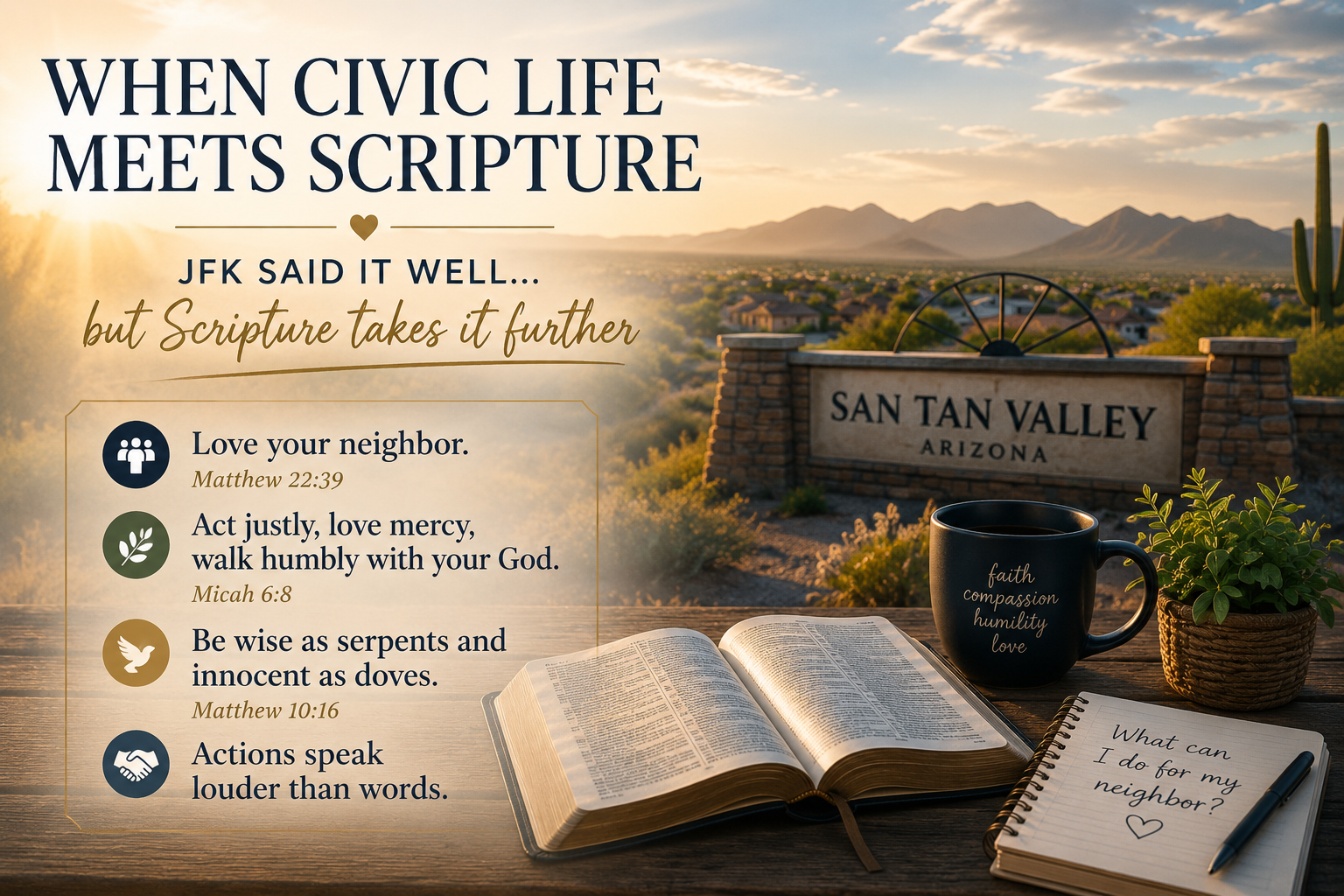
JFK said it well, but Scripture takes it further...
In a world increasingly divided, perhaps the question is no longer about country… but about neighbor.
Because communities are not only shaped by leadership…
but by the character of the people within them.
Being a citizen and attending town meetings for the newly established town of San Tan Valley, I am deeply grateful for how hard the board and its first employees are working to create something strong, beautiful, and intentional.
It is easy to forget—or perhaps never fully realize—just how much work there is to be done, what it entails, and all that is involved in each step of the process.
As humans, it can be easy to become critical, judgmental, and impatient—but what if we chose something different?
Perhaps even a bit extraordinary?
What if we chose to learn and seek understanding?
To trust the process, even when we don’t see the full picture?
To practice patience, respect, and gratitude?
To be resiliently and unabashedly kind?
What if we chose to believe people are working hard—
that they are doing their best with their experience, expertise, knowledge, and training?
What if we approached our public servants with curiosity… with grace… even with love?
As Paul writes in Colossians 3:12:
“Clothe yourselves with compassion, kindness, humility, gentleness, and patience.”
Reflecting on all the work that happens behind the scenes—for nearly everything—we might begin to ask:
How do we bridge the gap?
Perhaps we should not only be asking what this newly incorporated town can do for the roughly 100,000 citizens it already has…
but also ask:
What can we—as respectful, caring, committed citizens—do to help the process be successful?
Not just now… but always.
Regardless of whether we were alive to hear it or not, many recognize the phrase:
“Ask not what your country can do for you—ask what you can do for your country.”
And while I can appreciate what President John F. Kennedy expressed, I believe followers of Christ are called even deeper.
Not to tie our commitment solely to systems or nations—which can be influenced, manipulated, or misled—but to root our civic life in something stronger:
our shared humanity, creation, and ultimately, the desires of our Creator.
What if we began asking:
What can I do for my neighbor?
My friend? My community?
My colleague? A stranger?
Even the world around me?
As Scripture reminds us in Matthew 22:39:
“Love your neighbor as yourself.”
When we personalize who and what we are responsible for, we begin to connect more deeply—to one another and to the world immediately around us—rather than attaching ourselves blindly to organizations, political agendas, or even national identity.
In a world increasingly marked by division, perhaps what we need is not more expressions of patriotism—but rather more expressions of compassion. As well as a genuine desire to connect, learn, grow, understand.
Scripture calls us to something wise. Something grander.
As it is written in Micah 6:8:
“Act justly, love mercy, and walk humbly with your God.”
If we truly lived this way—embodying grace, compassion, patience, humility, justice, mercy, gentleness, love, and integrity—we might find that humility begins to replace division...
and understanding begins to quiet conflict.
Because transformation doesn’t begin with systems.
It begins with how we treat the people in our lives—
from those we live and work with, to the stranger right in front of us.
And as the age-old saying reminds us:
actions speak louder than words.
Perhaps the most powerful thing we can offer our town…
is not criticism for its own sake—
but constructive feedback paired with presence, participation, respect, appreciation, grace, and love.
And yet—this kind of compassion is not without the wisdom of caution.
Scripture also teaches discernment.
Yeshua Himself modeled both love and boundaries.
As it is written in Matthew 10:16:
“Behold, I am sending you out as sheep in the midst of wolves—so be wise as serpents and innocent as doves.”
Compassion does not mean becoming a doormat.
And grace does not require the absence of truth.
Challenging and even harmful relationships are something I hope to explore more deeply in the future—but for now, it is enough to say:
We are called to love wisely.
Called to live differently...
—with intention, discernment, and grace.
May the God of Abraham, Isaac, and Jacob grant us the insight to live kindly, love widely, and protect the light entrusted to us.

Comments ()