
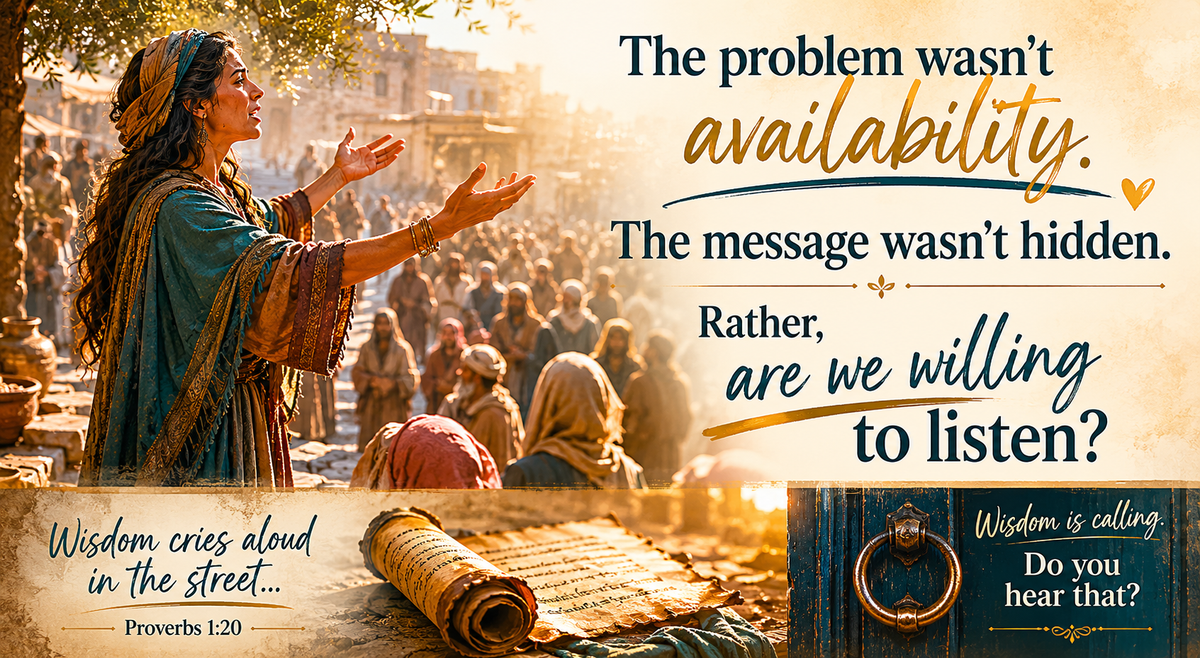
Do you hear that?
The problem wasn't availability. The message wasn't hidden. The question is whether we are willing to listen.
Proverbs 1-19 Solomon is preparing the reader. Instructing him, her, us, or them to let Wisdom be our Guide. Suddenly Wisdom takes the stage in Proverbs 1:20...
Seeking Wisdom by journeying through Proverbs.
Forewarning, this next section isn't merely direct, it is downright blunt.
To carry us through our next section —Proverbs 1: 20-33— I decided to quote my recently acquired New American Bible (NAB). It is from the Catholic Book Publishing Co.. Because of such, it does indeed contain the legendary, renowned, highly controversial books of the apocrypha.
Wisdom get's a voice!
With it she delivers a message I pray we all take more seriously to heart and change the course of our individual and collective thoughts and actions — inwardly and out-worldy (see what I did there? 😆).
Before we start though, a quick —and completely necessary— side step.
If you are like me, you might be wondering what I'm talking about when I mention "books of the apocrypha" and rightly so - after all, how can we know what we don't know and/or haven't learned, experienced, etc.?
What are the books of the apocrypha?
Apocrypha comes from Greek and means hidden. Also described as 'the missing books of the Bible', among other things.
These books can be found in certain other Bibles such as Eastern Orthodox, Catholic, and Ethiopian. Additionally, they can be found separately as well. I believe both as a collection and as individual references/books.
Highly debated and also acclaimed the apocrypha, hidden/missing additional books to Biblical and Hebrew history, are also called Intertestamental Literature.
Wisdom gets Real
In the next section of this chapter we are no longer being told about Wisdom, we get to meet her. She gets a voice, and boy does she have things to say!
Before we read her words, I'd like to paint a picture to help us step into the scene.
Imagine a bustling city. Crowed, full of people, likely noisy and perhaps chaotic.
Next, I'd like you to envision an observant woman coming forward from the crowd to speak to the people. Filled with passion she lifts up her hands and shouts pleading for any and all to listen...
NAB Proverbs 1: 20-33
"Wisdom in Person Gives Warning"
Wisdom cries aloud in the street,
in the open squares she raises her voice.
Down the crowded ways she calls out,
at the city gates she utters her words:
"How long, you simple ones, will you love inanity,
how long will you turn away at my reproof?
Lo! I will pour out to you my spirit,
I will acquaint you with my words.
Because I called and you refused,
I extended my hand and no one took notice;
Because you disdained all my counsel,
and my reproof you ignored—
I, in turn, will laugh at your doom;
I will mock when terror overtakes you;
when terror comes upon you like a storm,
and your doom approaches like a whirlwind;
when distress and anguish befall you.
Then they call me, but I answer not;
they seek me, but find me not;
because they hated knowledge,
and chose not the fear of the Lord;
They ignored my counsel,
they spurned all my reproof;
and in their arrogance they preferred arrogance,
and like fools they hated knowledge.
Now they must eat the fruit of their own way,
and with their own devices be glutted.
For the self-will of the simple kills them,
the smugness of fools destroys them.
But he who obeys me dwells in security,
in peace, without fear of harm."
Wow! That's a lot to take in.
What first strikes me is the fact that wisdom is in fact among the people.
She isn't some unknown, unobtainable, untouchable entity. No.
She is out in the streets, the square, the marketplace, the city gates.
She is where the everyday people are.
She is willing to meet them right out in the open, in person, wherever they gather, and whomever they may be..
Her words were not reserved for rulers or the Levites of God's Holy Temple.
She was speaking to ALL the people.
Wisdom isn't whispering from some distant mountaintop, in the king's quarters, or inside the Holy Temple. She is standing in the middle of everyday life crying out for anyone willing to listen. Wanting to hear and choose to follow her guidance.
What hits me immediately and right to the core is how obvious it is that it isn't her first time with and among them. Reaching out - in word and deed. I can feel her anguish as she pleads with them against their "love with inanity".
Again, I feel her pain and rejection as she speaks out about their distain of her counsel. The anguish from the hand she offered, words of love and guidance, herself extended to and for them, and the failed reproof (correction).
The problem wasn't (and isn't) availability.
Her message isn't hidden.
The problem is willingness.
Wanting.
The issue is receptivity.
Repentance.
Everything she tried was disdained, mocked, and ignored.
Including the very beginning of Knowledge - as we learn at the start of this chapter - actively choosing NOT to "fear" - Yirah, a deep profound love, admiration, etc., reverence for and of → → → - the Lord.
For more about Yirah
Read Embracing Wisdom (the second part of this chapter of Proverbs).
Everything she tried was disdained, mocked, and ignored.
How might you feel???
It definitely doesn't feel like the first time she has spoken either,—more like the thousandth.
The more I read and sit in the depth of her words, the more I feel her desperation.
Surely anyone who has repeatedly tried to help an unwilling, stubborn, fool-headed and fool-hearted person understands that, with this rejection, comes a feeling of hopelessness.
Because of such, her words sound far less like condemnation to me and far more like a desperate beseeching to save us from ourselves.
Not only is it gut-wrenching, devastating, and frustrating. Depleting even.
It is Exhausting, depleting even, to watch someone walk toward harm while refusing every warning.
There is a sorrow that comes from watching anyone—let alone those we love—make poor choices. Wisdom didn't fail to warn them. Rather every warning was rejected.
She is facing the heartbreaking reality that warnings ignored eventually become consequences. Consequences that can no longer be prevented.
Consequences she can no longer save them from.
Consequences that are not her desire, but the fruit of a path repeatedly embraced despite her pleas to turn away.
Wisdom's response is not the cruelty or callousness of someone enjoying another's suffering. She is mournful, grieved, even resigned.
Resigned to a reality she can no longer prevent.
Resigned to the fact that there comes a point when consequences can no longer be avoided because every warning has been rejected, every invitation ignored, and every outstretched hand refused.
This passage reveals that there comes a point when even Wisdom must acknowledge that she cannot choose for another what God-given freewill allows them to choose for themselves.
She is not indifferent.
Just accepting.
Accepting that their fate was never in her hands, but in their own choices.
And yet...
She is STILL trying!
How does one help someone unwilling to help themselves?
There is heartache behind the warning
Another important note is that Wisdom isn't warning solely about willingness to be or even remain ignorant. She's lamenting what people love.
Inanity, arrogance, ignorance, smugness. Ultimately, selfishness I think,
That's deeper than the mere rejection of knowledge.
They are attached to and actively choose foolishness and sin.
Driven by and delighting in their compulsions—behaving incorrigibly.
What also feels clearly evident from her words as she speaks out in one final warning for anyone who is willing to listen, is to repent before it's too late.
Repentance isn't simply an apology.
It is more. So much more.
Repentance is heartfelt, mindful, genuine remorse.
It is an active sustained effort to change behavior(s).
NOT doing or reverting back to the same old same old.
If Solomon was preparing the reader for the importance and insight to revere the Almighty and learn from Wisdom's guidance in Proverbs 1:1-19, then this section is Wisdom desperately and lovingly trying to stop someone from walking off a cliff they refuse to acknowledge exists.
Repentance is purposeful and purpose-filled.
It saves relationships, builds character, teaches reverence, strengthens growth, increases knowledge, connection, and understanding...
It allows for mercy and grace.
My Tree of Life Version (TLV) aptly entitles this section "Wisdom Calls, But Who Listens?" As my title hopefully suggests, the invitation is still being extended.
Perhaps even harder than choosing to even be open to receiving the words, the outstretched hand, the opportunities in everyday life, is accepting and—to the best of our ability at any given time—applying, even sharing, the message. The Wisdom. The lessons learned.
If Proverbs 1: 1-7 instructs that Fear of the Lord is the beginning, and Proverbs 1:8-19 is about listening to instruction, and Proverbs 1:20-33 is Wisdom calling, are we picking up what all these verses are putting down?
Reverence prepares the heart.
Instruction trains the mind.
Wisdom prepares the soul.
Yet Proverbs 1 may be offering something more.
Hidden within Wisdom's warning is another difficult lesson—one about letting go, free will, consequences, and the painful reality that we cannot choose for others what only they can choose for themselves.
We'll explore that next.
Thank you for reading and God Bless!
Additional Content:
A Little More for those Curious About the Apocrypha.
Why some Bibles contain additional books.
According to The Bible For Dummies, which I have really enjoyed, "most Jews held" these texts, the apocrypha, "in high esteem with "some even considering them a part" of Scripture. The apocrypha "were ultimately rejected" by Jewish Scholars because they were not believed to be "divinely inspired" and were therefore purposefully not included in the Hebrew Bible.
Interestingly enough, these books were a part of the early Christian church "until the Protestant Reformation in the sixteenth century" when they were removed from many Christian Bibles.
Whether one views these works as part of Scripture or valuable historical literature, they provide insight into the fascinating period between the Old and New Testaments. I know I wish I knew more about that time period.
As someone interested in the history, culture, etc., and beliefs surrounding the Bible, God's chosen people, and the story of Christ, I believe these books provide a window into the world that existed between the prophets of the Old Testament and the arrival of Jesus/Yeshua.
I personally look forward to reading them not only as additional resources and study material, but also as a fascinating history of the Bible itself!



Comments ()