The Extra Eyes and Ears Helping Monitor Elections
Who watches the election process? Discover who these independent witnesses are, what role they play in elections, and why understanding the process may be more important than you think.
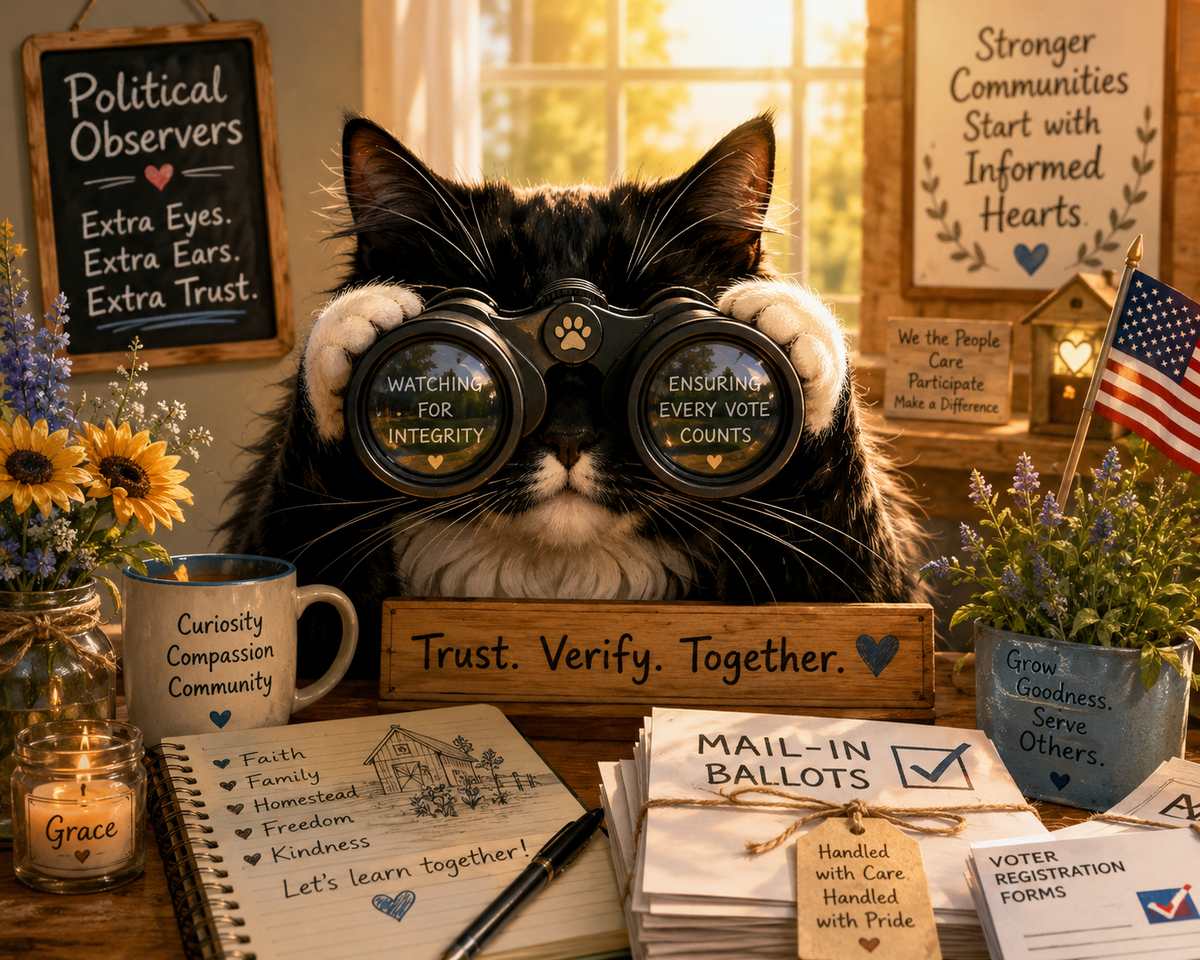
What The Function: Why Elections Have Independent Witnesses
Political Observers Explained:
Who They Are, What They Do, and Why It Matters.
Before touring the Pinal County Elections Department, I didn't know anything about the role myself, or that they existed, let alone what they did, how they were involved, or why they mattered.
As it turns out, Political Observers play an important part in helping ensure transparency and confidence in the election process.
But before we get there, let's start with the basics. Definitions.
According to the Cambridge Online Dictionary, an observer is “a person who watches what happens but has no active part”.
Utilizing the same website, political is an adjective that is described as “relating to politics.”
With those definitions, it can be safe to assume that a political observer is someone who keeps an eye on the details, accuracy, and happenings of a particular political event, such as an election.
A person who is objective, aware, and non-participatory in the process they are observing—hopefully with great integrity.
Preferably, someone who understands the protocols and processes they are witnessing to give honest, accurate, and specific feedback about what did or did not occur.
In simple terms, a Political Observer is someone who watches and monitors parts of the election process without actually running that process themselves.
Think of a Test Proctor in an important examination.
The proctor isn't there to take the test. They aren't there to influence the outcome. They aren't there to tell students what answers to choose.
Instead, they're there to observe.
They help ensure procedures are followed, rules are respected, and any concerns or irregularities are properly noted. They serve as an additional set of eyes and ears.
Political Observers serve a similar function for elections.
They are witnesses to the process.
By observing various stages of the operations and reporting what they see, they provide a layer of transparency and accountability that builds public confidence.
In many ways, they serve as an extra layer of verification in a system designed around trust, accuracy, and integrity.
What I Learned During My Visit
While visiting the Pinal County Elections Department, Recorder Dana Lewis graciously walked me through the facility and explained the many moving parts involved in administering elections.
One of the things I found most interesting was learning how everyday people can serve as Political Observers to fill an important role in the whole process.
As we walked through the facility, she explained not only what Political Observers do, but why she believes they are an important part of maintaining public trust.
The goal is pure observation—or as Dana beautifully put it, keeping "an eye on the process" to naturally ensure transparency and accountability
Political Observers are appointed and credentialed through their respective political parties. They receive training and are assigned to observe specific election activities.
Depending on the election and the circumstances, observers may be present during ballot processing, tabulation activities, audits, and other observable portions of the election process.
Observers are not there to run the election. They are there to watch it.
Why Elections Have Independent Witnesses
One thing I appreciated learning was that election observation is designed to include representation from multiple political perspectives.
In many situations, observers from different political parties may be present to witness the same process.
This helps create what Dana called a "trust, but verify" atmosphere.
Rather than relying solely on one individual, one office, or one group, multiple people are able to witness what occurs and report their observations.
Political Observers can help answer questions such as:
- Were procedures followed?
- Were ballots handled according to established protocols?
- Were concerns documented appropriately?
- Were processes conducted consistently?
Their role helps provide additional transparency and can help reduce misunderstandings, misinformation, and confusion surrounding election procedures.
Why Should You Care?
That's the real question, isn't it?
Whether Republican, Democrat, Independent, Libertarian, Conservative, or simply someone trying to make sense of the world around you, elections affect all of us.
The more we understand how our systems function,
the better equipped we are to participate thoughtfully and responsibly.
Political Observers are not election officials.
They do not determine outcomes.
They do not count as extra votes.
They are independent witnesses to specific election processes.
Their presence helps strengthen confidence that procedures are being followed and that concerns can be identified, documented, and addressed when necessary.
Political Observers are one small piece of the bigger picture.
We as citizens, actively, responsibly, and compassionately involved, are another.
The Role at a Glance
A Political Observer is:
✓ Hands off:
They strictly observe, leaving the actual operations to trained county staff
✓ Objective Witness:
Someone who serves as an independent witness to help uphold the integrity of the election process on behalf of the community.
✓ Appointed through a political party:
Typically Republican and Democrat.
What the Recorder, Dana Lewis, Wants the Public to Know?
During my visit, Dana repeatedly returned to one theme: transparency.
That the “trust but verify” atmosphere hopefully, helps to build confidence and reliability in the integrity of our United States Federal, State, County, and Local Elections.
For our local citizens she stresses:
- Pinal County elections and ballot drop boxes are secure.
- Pinal County does not have third-party vendors running their elections but rather utilizes them to come in and train PC staff.
- The public should reach out, ask questions, learn, and get involved.
- Local government resources exist to help citizens in a variety of ways.
She pointed to the county's live-stream cameras, updated facilities, security measures, audits, and observer access as examples of ways her office works to help the public understand what is happening and why.
Additionally they implemented various safeguards and protocol checks, such as GPS Locks for ballot boxes and cages for transportable confidential election data.
Dana said she advocates for Political Observers to be in her facilities across Pinal County and community. A county she strives to serve with excellence, sound thought-out responsible choices, a sense of community, and also great care.
As a military veteran herself, it is that much MORE important to Dana that each member of the local community, and the United States of America as a whole, has a voice and opportunity to be heard through an honest and fair election.
Political Observers are only one piece of that effort.
Food for Thought:
If we want confidence in our institutions, we should first be willing not only to understand how they function, but also engage with them thoughtfully and respectfully
On behalf of Ms. Lewis, her employees, volunteers, and Political Observers, I would like to remind those of you who choose to mail in their vote, that not only do people handle these —who may have allergies— but that they also go through various machines, and to do your best to keep your mail-in ballots Clean.
That means free of food, drinks, strong fragrances, bodily waste, pet hair, and other contaminants whenever possible.
While I am on the topic...
Free of hate speech (“love letters”) as well as harmful or toxic chemicals —yep, they deal with very real threats of all kinds and levels.
Although I would encourage you to contact your local government representatives about questions and concerns, please do not send out anything harmful, irresponsible, or threatening.
From one human being to another, I just ask for anyone reaching out to do so with patience and curiosity.
To practice courtesy, kindness, and respect.
Dana works hard to keep her staff safe and up to date with election and emergency training, PPE, and various security protocols. All of which also help to ensure the safety of the public (aka voters) as well as efficiency.
Lastly, do yourself and everyone else a favor by making sure you send in all your voter cards together, do not mix-up your documents up with someone else’s, and send them back on time.
Doing so is in everyone's best interest, but most especially yours as a voter.
There are many rules they need to follow as county, election, government workers, and/or political observers.
We make all their jobs easier and keep elections Accurate and Secure when WE as citizens not only comply but also behave responsibly as mature, kind, forgiving, intelligent, etc. voters and adults.
Additional... observations 😜
One other great point that Ms. Lewis made is one my husband taught me many moons ago: paying attention to local politics is just as—if not more—important than paying attention to federal politics.
Local government affects our everyday lives in countless ways.
I believe it is not just critical—it is an absolute privilege and responsibility for us as citizens to be informed, aware, and actively looking out for one another. To do so with kindness, respect, and care.
As important as it is to hold others accountable, we need to hold ourselves accountable also and remember to ask if we are treating others the way we hope people treat those we love...
If we want stronger communities, we should be willing to approach one another with curiosity, patience, respect, kindness, and a desire to genuinely understand.
To be open-minded and tolerant of opposing needs, viewpoints, and experiences. To listen with the intention to learn and grow as individuals and as communities.
Because regardless of our political views, informed and compassionate citizens are better equipped to participate in a healthy society than divided and uninformed ones.
After all.
How can we become more understanding of one another and connect through our individual experiences if we don't even try?
How can we understand what is happening if we aren't speaking with one another with genuine patience and a desire to understand the other person?
Let alone why, or better yet, how to make positive changes for as many as possible?
One of the biggest lessons I continue to appreciate is that curiosity is often more productive than assumptions.
As best we can, we should ask questions with the intention to seek understanding and build connections. To remain open to learning something new not only about our government, but about one another as individual people.
Remain Curious, take initiative, stay involved.
I am far from perfect in any and all ways - that's why I need God's Grace. With that, I believe in a world that loves and accepts one another.
I believe we have so much more to be thankful for in one another than divided.
I have much to learn—in writing, in government, and in life.
As always, I look forward to it.
My hope is that articles like this help us all become a little more informed, a little more curious, and a little more mindfully connected to our communities.
Thank you for reading, and God Bless!
Let's learn together!
What questions do you have?
Let me know in the comments, and I will do my best to learn about the topic and answer as best I can.
Additional info:
I asked Dana what resources she would recommend.
For our local Pinal County she shared the Pinal Votes website.
For an Educational Resource for the State of Arizona, The Citizens Clean Election page offers:
- Webinars
- Events
- Debates
Additionally, for free resources to learn about US government and politics, here is a wonderful reliable, donation funded, resource:
After watching the intro video, I can tell you I am very excited to take this course!
These also looked intriguing to me:
Another source I have used, but not for this particular topic yet:
- CrashCourse on YouTube
Here is the first episode 🥳😆🤩
Comments ()